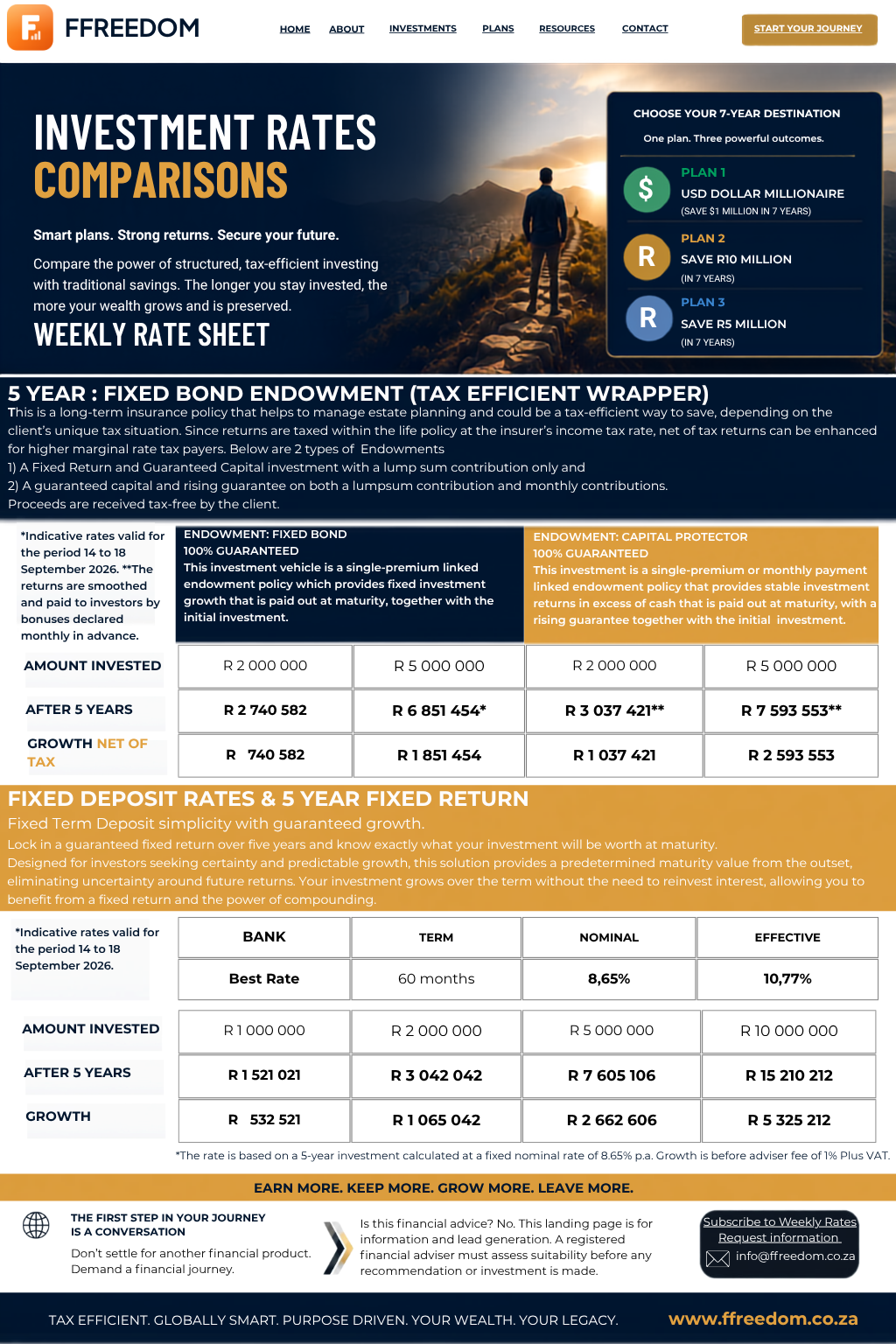
Interest rates move and providers update offers quickly. FFREEDOM’s Weekly Best Rates gives South African investors a simple place to check competitive options across savings, cash, fixed income and other income investments. Whether you need liquidity or steady income, seeing what is available today helps you decide.
Updated weekly
Keep up with changing market rates and opportunities across cash, deposits and income investments.
South Africa focused
See options relevant to South African investors with rand-based returns and local access terms.
Easy comparison
Quickly scan categories and terms to identify which options may suit your amount and timeline.
Beyond the headline rate
Understand risk, liquidity, fees and tax so you compare like with like before committing funds.
This weekly guide highlights the investment and savings rates available and shows where competitive returns may be available right now. Use it to compare options for tax-efficient fixed bonds & endowments, with cash, deposits, money market funds and other income investments based on term, access and risk.
What are the best rates this week?
Finding the right home for your money is not only about chasing the highest percentage. The best fit depends on how much you invest, how long you can commit funds, when you might need access, what risks you accept and how tax applies to your situation.
Our weekly page brings relevant opportunities together so you can quickly see which options look competitive today. Treat this as a market snapshot, not a permanent offer, because pricing can change without much notice.
Types of opportunities you may see
Tax-efficient fixed bonds and endowments
Savings and cash accounts with tiered or promotional rates
Fixed and notice deposits across different terms
Money market unit trusts and enhanced cash strategies
Income funds with diversified fixed-income holdings
Listed and over-the-counter fixed-income opportunities
Structured notes with defined terms and outcomes
Private-market income investments with specific mandates
Why checking rates regularly matters
Small differences add up. On a R1 000 000 balance, a 1% difference in annual interest is about R10 000 before tax over a year, assuming the same capital. Over longer periods, or on larger balances, that gap can become meaningful to your cash flow.
Banks, asset managers and specialist providers revise pricing as market rates move. A quick weekly review helps you avoid leaving surplus cash in an uncompetitive account and can guide you toward options that better match your needs.
By revisiting the best available investment and savings rates each week, you keep your plan aligned with current conditions rather than last month’s offers.
What we look for in the weekly selection
Our goal is not to publish the biggest number. We aim to add useful context so you understand what you are comparing. Key considerations include the provider, the underlying assets or obligations, the expected term, early-access rules, costs and likely after-tax outcomes.
Provider quality: Who stands behind the promise to pay, and how is the investment regulated or governed?
Liquidity and term: Is your capital available on demand, after notice, or only at maturity?
Capital profile: Is your capital guaranteed, stable in value, or subject to market movement?
Fees and costs: How do administration fees, platform costs or penalties affect your net return?
Tax treatment: How will interest, dividends or gains be taxed in your hands?
Rate versus risk the number is not everything
A higher headline rate does not automatically mean a better investment. A bank deposit, a money market fund, a corporate bond, a structured product and a private-credit mandate can all produce income, but they carry different risks and access rules.
Questions to ask before you invest
What assets or obligations support the return, and how might they behave in stressed markets?
How long is your money committed, and what happens if you need it earlier than planned?
Is the quoted rate fixed, variable or indicative, and how often can it change?
What are the tax implications for you, and are there available allowances you can use?
The most attractive option is the one that balances return, risk, liquidity and tax efficiency for your circumstances. Use the weekly snapshot to shortlist ideas, then assess them against your plan.
Make this check part of your wealth routine
Interest rates and opportunities evolve. Your approach should, too. A five-minute scan of current options may improve outcomes without taking unnecessary risk, especially if you hold significant cash in a practice, company or trust.
Compare: See how similar terms from different providers stack up.
Review: Test whether your existing accounts remain competitive.
Plan: Match terms to known expenses and upcoming goals.
Diversify: Consider options beyond a single bank account where appropriate.
Optimise: Aim for a fair rate while keeping required access.
This habit is particularly relevant for professionals, medical specialists and business owners with surplus cash that needs to be efficient while it waits for its purpose.
Important notes before you invest
Rates vary by investment amount, term, provider and investor profile, and are subject to change and availability. Returns are not guaranteed unless expressly stated in the product terms. Product documents set out the rules on access, fees and penalties.
Tax outcomes depend on your situation. Interest is generally taxable, subject to available allowances, while distributions from funds or other products may be treated differently. Fixed bond endowments are a long-term insurance policy that helps to manage estate planning and could be a tax-efficient way to save, depending on the client’s unique tax situation. Since returns are taxed within the life policy at the insurer’s income tax rate, net of tax returns can be enhanced for higher marginal rate tax payers. Consider speaking to a licensed adviser or tax practitioner before committing capital.
Find the right option for your money
The highest rate is not always the right rate. FFREEDOM can help you compare structures, terms and risks so your selection fits your objectives and timeline. Use this page to start your shortlist, then decide what suits you best.
Come back each week to see the best investment and savings rates alongside clear context on term, access and risk. Your money should have a purpose, and it should earn an appropriate return while it waits.
“The weekly snapshot helps me keep surplus practice cash in the right place without overcomplicating things. Five minutes, better decisions.”
Frequently asked questions
How often is this page updated?
We update the selection weekly to reflect current market conditions. Offers can change at short notice, so treat the page as a snapshot rather than a standing quote.
Do the highlighted rates apply to everyone?
Not always. Rates can depend on investment amount, term, provider rules and investor profile. Always confirm the rate, eligibility and costs before you invest.
Are the returns guaranteed?
Only products that explicitly guarantee capital or a rate in their terms offer certainty, and even then conditions apply. Funds and market-linked options can fluctuate and may deliver different outcomes.
What about tax on interest and income?
Tax depends on your circumstances and the product structure. Interest is generally taxable, subject to allowances, while fund distributions may be treated differently. Seek professional advice if unsure.
Can FFREEDOM help me choose an option?
Yes. We can refer you to accredited adviser to find the most suitable option, compare structures, terms and risks against your objectives and liquidity needs. Use the weekly page to shortlist, then request guidance if required.
What is the best investment rate in South Africa?
There is no single best rate for every investor. The appropriate rate depends on factors such as the investment term, liquidity requirements, risk tolerance, investment amount, provider and tax position.
Are higher interest rates or returns always better?
No. A higher rate or return can involve greater investment risk, longer lock-in periods or lower liquidity. Investors should assess the return in relation to the risk and conditions attached to the investment.
Should I move my savings when another provider offers a higher rate?
Not necessarily. Before moving money, compare the full terms, including fees, withdrawal restrictions, tax implications, guarantees, credit risk and the duration for which the advertised rate applies.
Why should I check investment rates every week?
Rates can change as market conditions change. Regularly reviewing available rates can help investors identify potentially more competitive opportunities and avoid leaving excess cash in an investment that is no longer competitive.
What is a nominal rate?
The interest rate before considering inflation, fees or compounding interest.
What is an effective rate?
The real return that considers the effects of compounding interest and any fees charged over time.
What are the tax implications for a fixed term deposit?
This is an interest-bearing investment product and interest is taxable in the hands of the investor. There is no capital gains tax payable. Tax numbers are mandatory to report to SARS for tax purposes.
What type of risk profile should an investor be to invest into fixed bonds and fixed term deposits?
conservative risk profile makes it popular with retirees and clients with a conservative risk appetite.
Which financial advisor is qualified to advise on this product?
Financial advisors require a Category I license for Participatory Interests in a Collective Investment Scheme (1.14), i.e., Unit Trusts to render services in this product.
This is paid partner content. FFREEDOM's editorial team was not involved in producing it, and publication does not constitute an endorsement or financial advice. FFREEDOM is a product of 1st Group Capital (Pty) Ltd, an authorised financial services provider (FSP 49632).