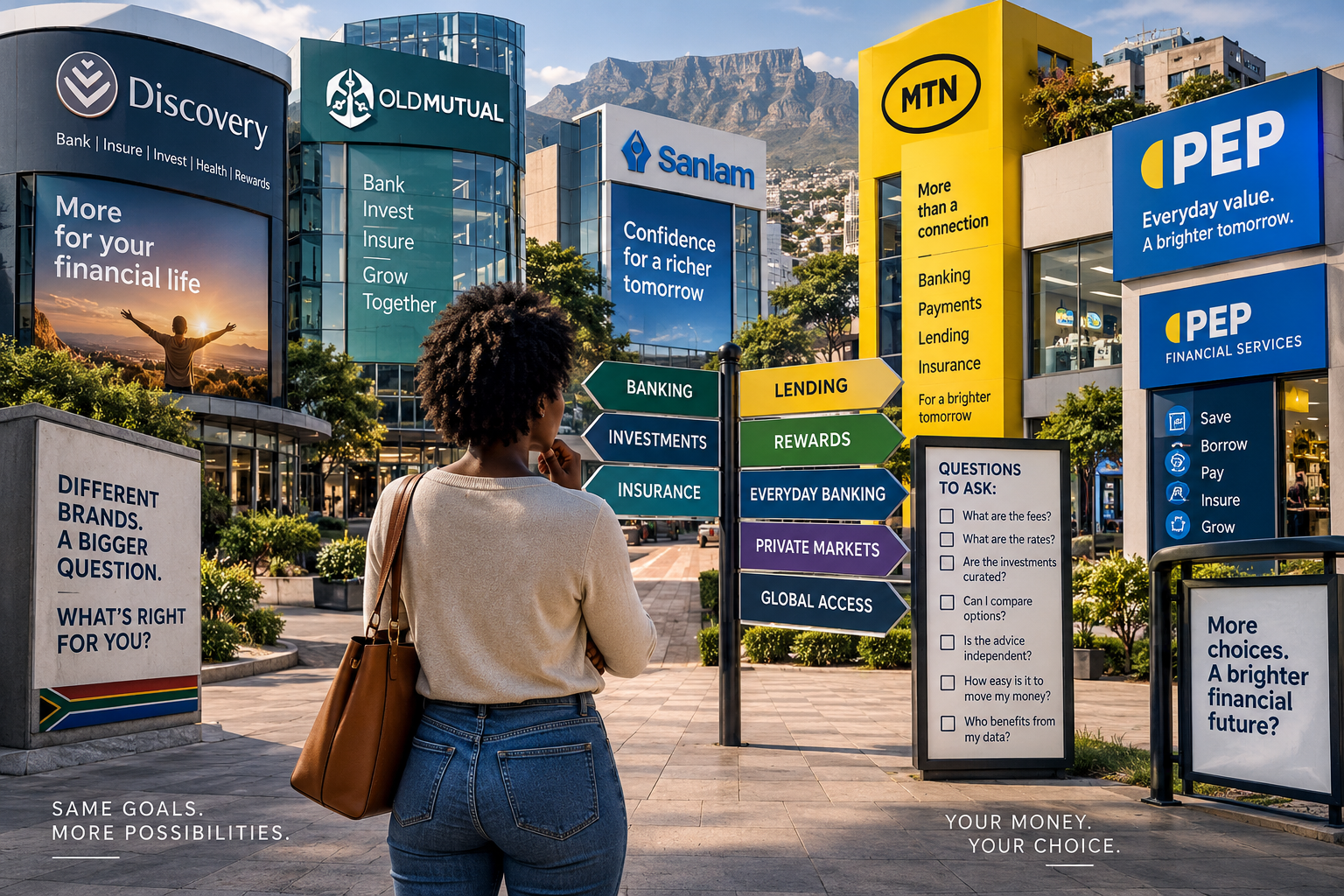
And what does it mean for your money, your choices and your financial adviser?
It seems everyone wants to be a bank.
Discovery has one. Old Mutual has launched OM Bank. Pepkor is building its own bank. Sanlam is bringing banking products to customers through GoTyme, while MTN is considering banking licences in selected markets.
But why?
The obvious answer is deposits.
A bank account isn't just about charging you banking fees. Deposits provide funding. A company with millions of customers can potentially turn those deposits into lending, payments and a much deeper financial relationship.
Pepkor has been particularly open about this. Its banking strategy targets R8 billion of deposits and R8 billion of loans by its fifth year.
But there is another reason.
Banks interact with you all the time.
Your salary arrives.
You pay your debit orders.
You buy groceries.
You transfer money.
You check your balance.
You use your card.
You save.
You borrow.
Compare that with a traditional life or investment company. You might speak to them once or twice a year — perhaps when your adviser reviews your retirement plan, investment portfolio or insurance.
That creates a huge difference.
Frequency creates opportunity
The more frequently a company interacts with you, the more opportunities it has to understand your financial behaviour and introduce other products.
Discovery provides a fascinating example. It has described Discovery Bank as the group's "operating system" and has integrated banking with its Health, Life, Insure, Invest and rewards businesses.
Discovery has also said bank transaction data can help it better understand customers and price insurance.
This is powerful.
But it raises an important consumer question:
Is the ecosystem being built for my convenience — or to make it easier to sell me more products?
The answer can be both.
And that is why customers need to remain curious.
SUBSCRIBE to FFREEDOM — South African money journalism and financial education
What happens when your financial world becomes a "Truman Show"?
Imagine opening your investment app and seeing a beautifully curated selection of funds, portfolios and investment products.
Everything looks convenient.
Everything appears relevant.
But how much of the investment universe are you actually seeing?
Are you seeing the whole marketplace?
Or only the products manufactured, owned, distributed or preferred by the institution behind the platform?
That is the question worth asking.
Because there is a subtle difference between:
"Here are the investments available to you."
and
"Here are the investments we have chosen to show you."
This doesn't mean curated investment platforms are automatically bad. Curation can simplify an overwhelming marketplace.
But consumers should know when convenience becomes a limitation on choice.
The democratisation of investing has already started
This is not a completely new phenomenon.
The democratisation of investment markets began more than a decade ago.
ETFs were one of the clearest examples.
Instead of needing to select individual shares or pay for an expensive actively managed portfolio, investors could buy a low-cost basket representing an index or market.
Then came cheaper online platforms, fractional investing, global investment access and increasingly sophisticated digital wealth tools.
Now South Africa is catching up with another part of the story:
private markets and alternative investments.
Private credit, infrastructure, private equity, property and structured investments are increasingly finding ways to reach investors who previously had limited access.
The investment world is therefore moving from:
"What does my institution offer?"
towards:
"What does the investment universe offer?"
That is a profound change.
And now the infrastructure itself is changing
The really interesting part is what is happening globally.
On 21 September 2026, the Eurosystem launched Pontes, allowing wholesale transactions in tokenised assets to settle in central-bank money. The ECB also announced that it is preparing to invest a small portion of its own funds in tokenised securities.
That doesn't mean your bank account is suddenly running on blockchain.
It does mean that major financial infrastructure is beginning to accommodate tokenised securities and distributed-ledger technology as part of mainstream financial-market infrastructure.
In the United States, banking regulators have likewise clarified that eligible tokenised securities can receive the same capital treatment as their traditional equivalents and, if they meet the rules for financial collateral, can qualify as collateral for banks.
The direction of travel is becoming clearer:
financial assets are becoming increasingly digital, programmable, divisible and portable.
So why does everyone want your banking relationship?
Because banking can become the front door.
Once a company has your banking relationship, it has far more opportunities to become part of your financial life.
That could be extremely convenient.
But consumers should ask:
Am I receiving genuine choice?
Can I compare products outside this ecosystem?
Are the investments being shown to me independently selected?
What am I paying for the convenience?
Is the person advising me independent of the manufacturer?
Who owns my data?
Can I move my investments elsewhere easily?
Am I being offered the most appropriate solution — or simply the next product in the ecosystem?
These aren't anti-bank questions.
They are pro-consumer questions.
Interesting times ahead
The financial world is changing faster than many traditional institutions expected.
Banks want insurance.
Insurers want banking.
Retailers want deposits.
Telecom companies want financial services.
Investment platforms want your entire portfolio.
Fintech wants to remove friction.
And investors increasingly want access to markets that were once reserved for institutions.
Perhaps the biggest change is that the consumer is moving from being a product buyer to becoming a market participant.
The winners of this next phase may not simply be the companies with the most products.
They may be the companies that give customers the greatest combination of:
choice + transparency + technology + speed + trusted advice.
So yes, it is interesting times.
But perhaps the most important question isn't:
"Why does everyone suddenly want to be a bank?"
It is:
"If everyone wants to own my financial relationship, who is making sure that I still own my financial choices?"
That is a question worth asking before you click "Apply Now.
SUBSCRIBE to FFREEDOM — South African money journalism and financial education
Sources
https://www.businessbagel.com/why-south-african-companies-are-launching-banks/