
South Africans will remember the sharp JSE sell-off earlier this year, when the market fell around 4% in a single trading day.
Such movements highlight an uncomfortable reality for investors: when markets become stressed, assets that appear diversified can sometimes fall together.
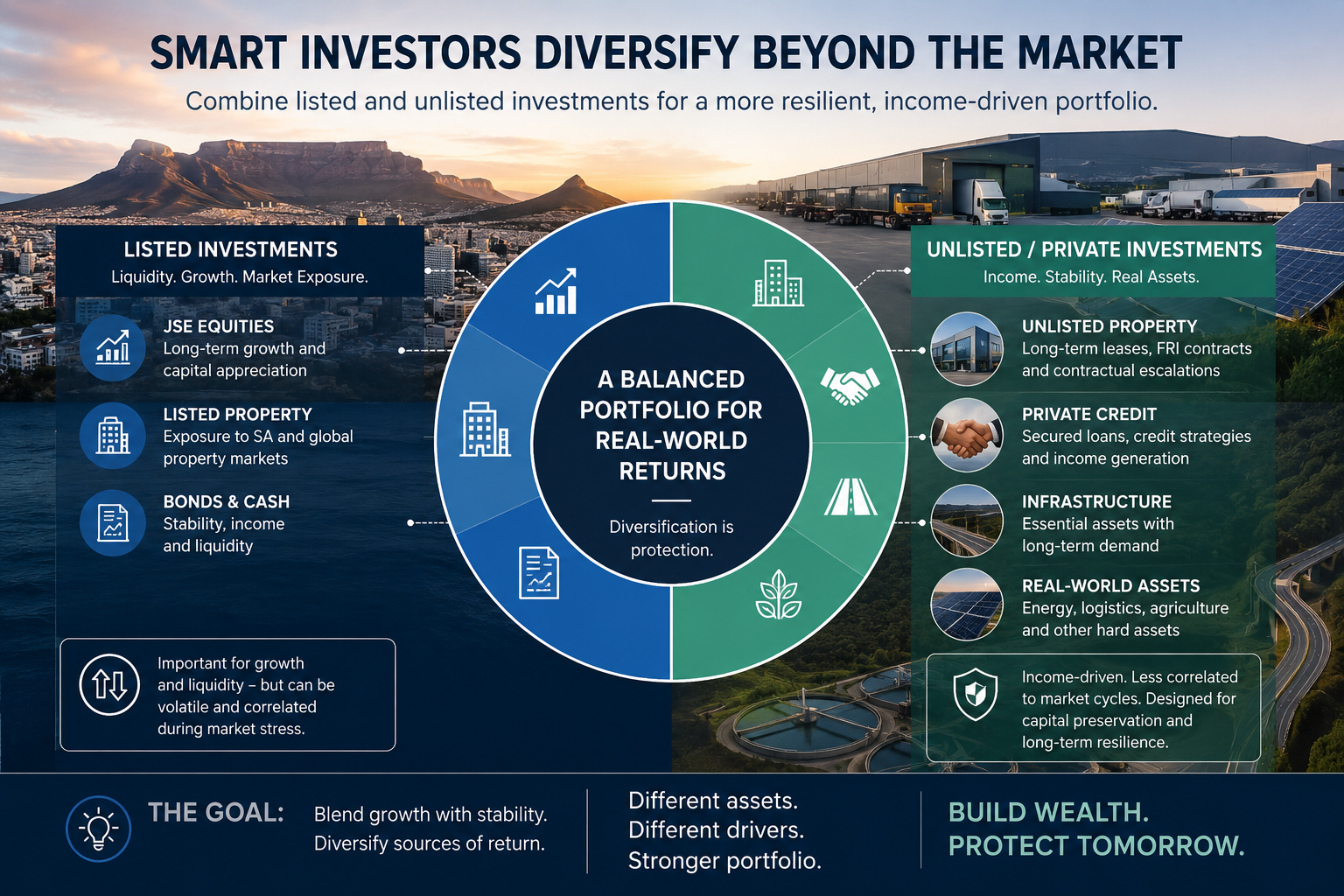
This is why an increasing number of sophisticated investors are looking beyond traditional listed shares and bonds towards uncorrelated investments, private markets and real-world assets.
The Problem With Traditional Diversification
A portfolio containing equities, listed property and bonds may look diversified on paper. But during periods of market stress, correlations can rise sharply.
When investors rush to reduce risk, different listed assets can experience simultaneous selling.
The result? Diversification can disappear precisely when investors need it most.
This has led investors to ask a different question: What assets can generate returns from sources other than daily market sentiment?
What Are Uncorrelated Investments
Uncorrelated investments are assets whose returns are less dependent on the movements of traditional financial markets.
Instead, their performance may be driven by contractual income, long-term leases, real-world usage, credit agreements or underlying asset performance.
Examples can include:
Unlisted commercial property
Private credit
Infrastructure
Logistics assets
Certain real-world assets
Contractual income strategies
They are not risk-free. Rather, their potential value lies in having different drivers of return.
Why Private Markets Are Becoming More Important
Private markets have historically been dominated by institutions, family offices and ultra-high-net-worth investors.
That is changing.
Greater access to private-market structures is allowing a broader group of sophisticated investors to consider assets that were previously difficult to access.
For South African investors, this can create opportunities to diversify beyond the JSE and traditional unit trusts.
Unlisted Property: Income Rather Than Daily Price Movements
Unlisted commercial property provides a useful example.
A property backed by long-term leases, fully repairing and insuring (FRI) agreements and contractual rental escalations can generate income based on the underlying property and tenant agreements.
Unlike a listed property share, the underlying property is not repriced every second by the market.
The property can continue collecting rent even when listed markets are experiencing significant volatility.
Building a More Resilient Portfolio
The answer is not to abandon listed investments.
Equities, bonds and listed property remain important components of long-term portfolios.
The opportunity is to consider whether a portfolio should also contain investments with different sources of return and lower correlation to traditional markets.
For investors seeking greater diversification, private markets, unlisted property and other real-world assets may provide an additional layer of portfolio resilience.
The Bottom Line
The lesson from JSE volatility is simple: true diversification is about behaviour, not labels.
If every investment in your portfolio depends on the same market conditions, diversification may be less effective than it appears.
The next evolution of portfolio construction could therefore involve combining traditional listed investments with carefully selected uncorrelated investments and private-market opportunities.
Could Your Portfolio Be More Diversified?
Your wealth should not depend on one market.