
How Structured Products Can Deliver More Defined Investment Outcomes
Markets can be unpredictable. Interest rates move, currencies fluctuate and global events can quickly change investor sentiment.
For investors who want growth but are uncomfortable with the full ups and downs of traditional equity markets, structured products can offer an alternative.
They are not designed to replace shares, bonds or cash. Instead, they can be used as part of a diversified portfolio to create a more clearly defined investment outcome.
Markets are wild right now, and global drama stirring the pot. It’s enough to make any investor think: “Do I ride this rollercoaster or bail and miss the ride?” Good news: there’s a third option that’s like a chill middle ground, that is structured products. They’re not as famous as stocks or bonds, but they’re a slick way to diversify and get clearer outcomes without the stress.
So, what exactly is a structured product?
In simple terms, a structured product is an investment linked to an underlying asset, index or group of companies.
Instead of simply buying the underlying investment, the investor agrees to a set of rules upfront.
Depending on the product, you might receive:
· A predetermined return if certain conditions are met.
· A percentage of the growth in an index.
· Enhanced participation in market gains.
· Capital protection, provided certain conditions are not breached.
For example, a structured product could be linked to the S&P 500 or a basket of large international companies.
The important point is that the return is determined by the structure of the investment, not simply by whether the market goes up or down.
Why are investors considering them
Structured products have traditionally been associated with sophisticated investors and private banks, particularly in European and UK markets.
They are increasingly accessible to South African investors through investment platforms and specialist providers.
They can be particularly useful for investors who:
· Want offshore market exposure.
· Want growth potential but are uncomfortable with full equity-market volatility.
· Are approaching retirement and want more defined investment outcomes.
· Prefer a three- to five-year investment horizon.
· Want to reduce the temptation to panic-sell during market corrections.
The attraction is simple: you know the investment rules before you invest.
Two common types of structured products
Autocalls: These pay a set return (say, 10% a year) if the linked index is flat or up at checkpoints (like yearly). Hit the mark, and it “calls” early, handing you your cash plus profit. If not, it keeps rolling till the end, often with capital protection unless the market crashes big (e.g., drops over 50%).
Participation Notes: These give you a slice of the index’s upside—sometimes more than 100%. Example: if the index jumps 10% over 5 years, a 200% note gives you 20%. If the index stays above a safety line (like 70%), your capital’s safe. If it dips lower, you might take a hit.
Bottom Line
Structured products aren’t here to replace your shares or emergency savings, but they add a layer of certainty that’s hard to beat in today’s chaos. They’re like a smart bet with a safety net, offering growth potential, less risk, and no need to obsess over market swings. Chat with your adviser and see if they fit your game plan!
An important question: can your adviser actually advise on them?
Speak to a qualified adviser to get access to Structured Products.
This is an area many investors may overlook.
Not every financial adviser is authorised to provide advice or intermediary services across every type of financial product.
Under FAIS, FSPs must have the appropriate authorisation for the relevant financial-product subcategory and the type of financial service being provided. The FSCA specifically warns investors to check whether an adviser is authorised for the category of advice they are receiving, particularly where more complex or higher-risk products are involved.
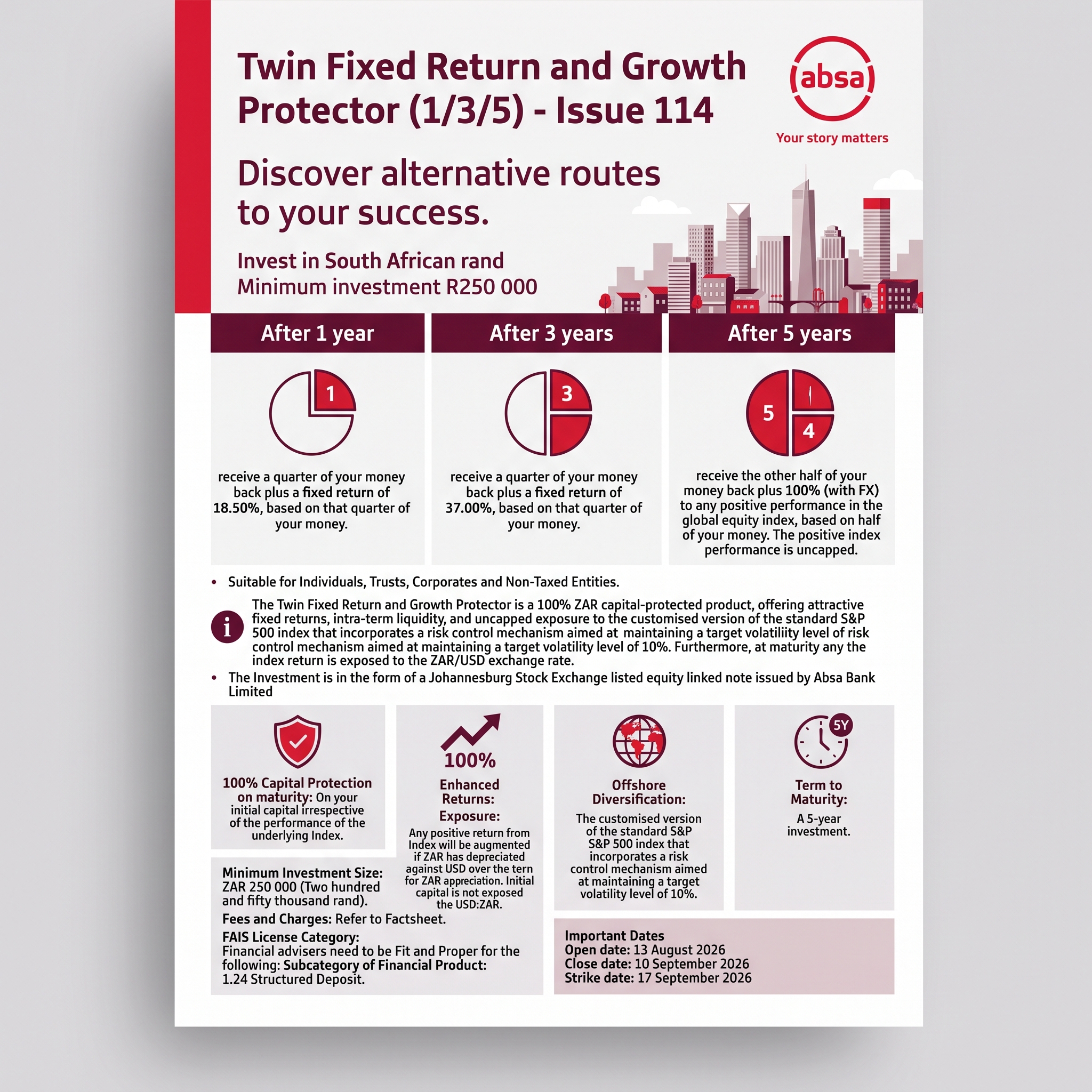
Source links:
Moneyweb – Have You Considered Investing in Structured Products?
Moneyweb – Is It Time to Consider Structured Products?