
Interest Rates Have Increased. Oil Prices Remain Persistently High. What Should Investors Do?
Higher interest rates and stubborn oil prices are putting pressure on South African households and investment portfolios. Investors can respond by reviewing cash reserves, managing debt, diversifying income sources and maintaining a disciplined long-term strategy.
Protecting wealth when inflation, borrowing costs and market uncertainty collide
South African investors are facing a challenging combination of rising interest rates, persistent oil prices and geopolitical uncertainty. The South African Reserve Bank's decision to raise the repo rate to 7.25% while the prime interest rate of commercial banks will increase to 10.75%, adds pressure to borrowing costs, while higher fuel prices threaten to push up household expenses and business costs.
For investors, the challenge is not simply finding the highest return. It is protecting purchasing power, preserving liquidity and building a portfolio that can withstand changing economic conditions.
1. Rethink cash and income investments
Higher interest rates can create opportunities for investors seeking income through money market funds, fixed deposits and short-duration income investments.
However, a higher nominal interest rate does not automatically translate into a positive real return. Inflation, fees and tax all affect the income investors ultimately retain.
Cash can provide liquidity and stability, but holding too much for too long may erode purchasing power.
2. Review bond and interest-rate exposure
When interest rates rise, existing fixed-rate bonds can lose market value, particularly those with longer maturities.
Investors should understand the difference between short-duration bonds, longer-term fixed-rate investments and floating-rate instruments.
The right balance depends on investment objectives, income requirements and the ability to tolerate fluctuations in capital value.
3. Avoid emotional decisions about equities
Market uncertainty can trigger volatility as higher borrowing costs and weaker consumer spending affect company earnings.
Businesses with strong balance sheets, sustainable cash flows and pricing power may be better positioned to navigate difficult conditions.
Investors with long-term horizons should assess the fundamentals of their investments rather than reacting to every market movement.
4. Reassess debt and property exposure
Higher interest rates can increase financing costs, affect property valuations and put pressure on leveraged investments.
Property investors should review rental income, contractual rental escalations, debt obligations and refinancing risks.
Households should also assess variable-rate home loans and other interest-sensitive debt to understand how higher repayments may affect their financial resilience.
5. Diversify and prepare for uncertainty
A resilient portfolio should not depend on a single asset class or economic outcome.
Depending on their circumstances, investors may consider a combination of cash, bonds, equities, property and offshore investments.
Diversification does not eliminate losses, but it can reduce dependence on a single source of income or return.
The bottom line
Don't chase yield. Don't panic-sell. Don't assume interest rates have peaked.
Investors should focus on liquidity, sustainable income, manageable debt and diversification.
The objective is not to predict the next interest-rate decision or oil price movement. It is to build a portfolio that can withstand different economic scenarios while remaining aligned with long-term financial goals.
This article is for educational purposes only and does not constitute personalised financial advice.
Download the Investor Resilience Checklist
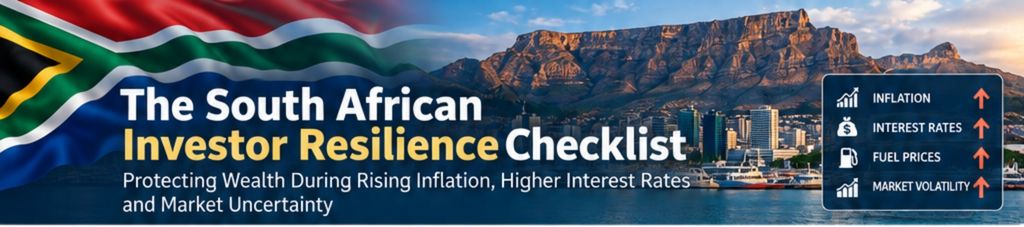
How resilient is your financial position in a changing market?
Rising inflation, higher interest rates and market uncertainty make it essential to understand where your finances may be vulnerable.
Our South African Investor Resilience Checklist is a practical tool designed to help you assess your household finances, investment portfolio, debt exposure, inflation protection and financial behaviour.
Use it to identify potential weaknesses, strengthen your financial foundations and take practical steps towards building long-term wealth.
Download the Investor Resilience Checklist and assess how prepared you are for the next market cycle.