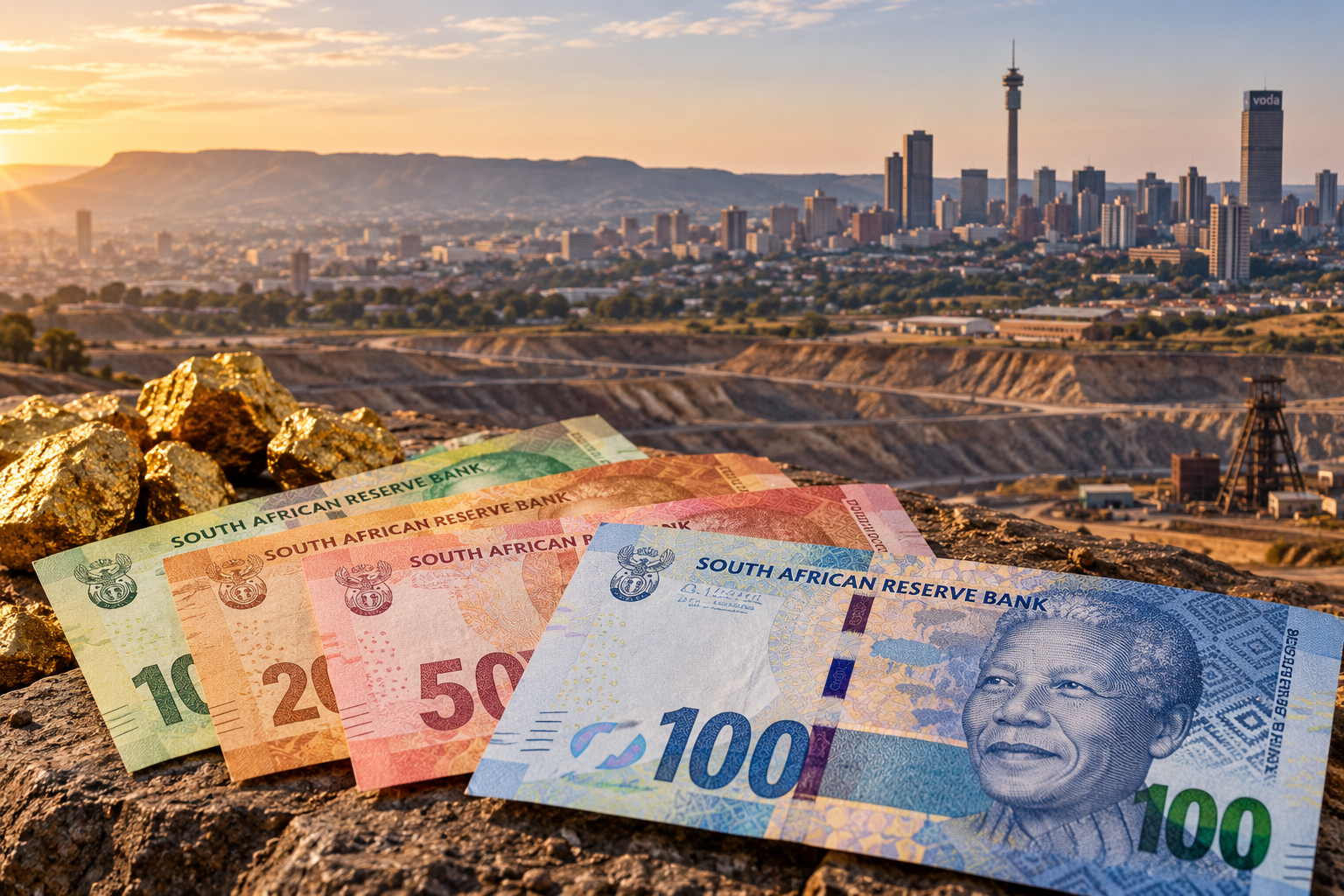
Most South Africans use the word rand every day.
We earn rands, spend rands, save rands and complain when the rand weakens against the dollar. But have you ever wondered where the name actually came from?
How the rand got its name traces directly to the Witwatersrand, the ridge around Johannesburg whose gold transformed South Africa’s economy. When the country adopted a decimal system in 1961, it chose “rand” to anchor the new money to the landscape that had funded modern finance.
Origins on the Witwatersrand
The Witwatersrand is a long, elevated geological ridge that arcs across Gauteng. Its name is commonly translated as “white waters’ ridge,” a reference to the light-coloured quartzite and the streams that once flowed over it.
Gold-bearing reefs in this formation made the area globally significant. Prospectors discovered payable deposits in 1886, setting off a rush that would redraw South Africa’s economic map. The find concentrated people, capital and infrastructure on an unprecedented scale.
Johannesburg grew atop this ridge because of the Witwatersrand’s ore. Shafts, stamp mills and processing plants rose on what had been open grassland. The name of the ridge became shorthand for an industry that generated export earnings, employment and state revenue for decades.
If you have wondered how the rand got its name, the answer begins with this geology. The currency’s identity reflects the place that spun a mining frontier into an urban and financial hub.
Gold rush and the birth of Johannesburg
Johannesburg’s early decades were defined by mining but also by the organisations required to fund, insure and supply it. The goldfields did not merely create mines; they catalysed a broader ecosystem that professionalised finance in the region.
Around the shafts, a cluster of services and markets grew:
banks to raise and channel capital into deep-level mining
insurance companies to manage risks and life cover for workers
transport firms to move ore, machinery and people
property developers to house a fast-growing workforce and business class
brokerages and exchanges that evolved into a sophisticated capital market
This network turned Johannesburg into South Africa’s commercial centre. The Witwatersrand brand carried connotations of enterprise, investment and hard currency earnings, long before the country named its money after the ridge.
From pounds to decimals and a new name
For much of the 20th century, South Africans used the South African pound, aligned with the British pounds, shillings and pence system. It was intricate: one pound equalled 20 shillings, and each shilling contained 12 pennies.
By the 1950s, momentum built to simplify everyday transactions and accounting by moving to decimals. In 1956, the government appointed a Decimal Coinage Commission to study the shift and recommend a framework.
The commission’s work paved the way for a new, decimal currency divided into 100 cents. That created a second, symbolic question: what to call the unit that would replace the pound and distinguish a new monetary era?
The answer connected money to place. The authorities selected “rand,” deliberately evoking the Witwatersrand, the source of the gold that had underpinned growth, foreign exchange earnings and the rise of modern Johannesburg. In choosing a name, policymakers tied the currency to the ridge’s economic legacy rather than to a figurehead.
Launch of the rand in 1961
The rand officially entered circulation on 14 February 1961, replacing the South African pound. The conversion was set at £1 to R2, easing the switch for consumers and businesses accustomed to the old system.
The new unit was decimal, with one rand equal to 100 cents. Initial banknotes appeared in denominations of R1, R2, R10 and R20, signalling a fresh start for pricing, ledgers and wage packets.
A name anchored in place, not politics
The symbolism was notable. The currency was not named after a politician, monarch or president. It drew its identity from a terrain feature associated with resources, entrepreneurship and investment—factors that had propelled the economy’s industrialisation.
That choice still resonates. The rand’s name encodes the story of a gold rush that seeded a city, built institutions and connected South Africa to global capital flows.
What the name still tells us
Currencies are artefacts of history as much as tools of trade. The rand’s name reminds users that money sits at the intersection of geology, policy and markets. It carries traces of decisions made in a mining camp and in a commission room decades later.
For investors and savers, this context matters. Exchange rates, interest rates and asset prices all respond to underlying structures—resource endowments, regulatory choices, trade patterns and business development—that evolve over time.
When you read a bank statement, sign a property transfer or review a portfolio, the “R” symbol is more than a unit mark. It is a pointer to the Witwatersrand, to Johannesburg’s ascent, and to a national journey from imperial denominations to a homegrown, decimal currency.
That is how the rand got its name, and why the choice endures. It began with a ridge of land, a fever for gold and the rapid urban and financial transformation of South Africa. More than a century after the first strikes, the rand remains a piece of economic history in your pocket.